My mentor challenged the pitch
Bill Furlong gave me 15 difficult investor questions. I've woven my answers into the presentation instead of saving every important point for Q&A.
I spent seven years building original creator technology. Now I want to build the company around it.
Real Video Creator is deployed. Real Gamers has a working native streaming engine. I am seeking $500,000 to hire the people and build the distribution needed to commercialize both as one creator ecosystem.
Founder-reported figures. Real Gamers and RVC are not yet directly integrated.
The story is mine. VoiceLab helps me tell it, and these visuals show the work.
I intended to pitch without a script, but laryngitis got in the way. The narration you're hearing is my own cloned voice from VoiceLab, reading words I wrote. I expanded this deck so you can see the actual products and demonstrations while I explain them.
Bill Furlong gave me 15 difficult investor questions. I've woven my answers into the presentation instead of saving every important point for Q&A.
You'll see RVC's working interface, Real Gamers' live controls, a side-by-side broadcast, and the Selected Creator enrollment flow.
For this pitch I generated and downloaded nearly 20,000 characters of narration with my VoiceLab voice in about 40 minutes. This is my observed workflow, not a certified speed benchmark.
I was a creator long before I was raising capital.
I started with video-game scripts and kept expanding into capture, graphics, video production and voice. I self-funded the work and historically spent about $190 a month in cash, excluding years of unpaid labor. My first launch taught me that shipping technology is not the same as finding customers.

I sought mentorship from Bill Furlong to turn engineering into a focused commercial plan.
I used established tools. The friction was everything between them.
Capture the moment. Transfer files. Find a clip. Edit the footage. Generate narration elsewhere. Make channel graphics. Export again. Each handoff steals time from the actual creative work.
RVC provides a browser-based creator Studio for editing, narration, collaboration and export.
I am building direct Real Gamers-to-RVC clip transfer so capture and production feel like one workflow.
The combined cross-product workflow is planned, not yet released.
The creator economy is large. My first addressable group is deliberately narrow.
Goldman Sachs described roughly 50 million creators globally in a 2023 research note. IAB reported that U.S. creator advertising reached $37 billion in 2025. Those numbers show category activity, not RVC software demand or my revenue opportunity.
Category figures are not an RVC TAM forecast. See the Sources section for dated primary research.
An editable-first workspace, with AI available when the creator chooses.
RVC includes a multi-track timeline, mobile-to-project capture, media handling, exports, collaboration, VoiceLab, generation workflows, account management and payment infrastructure.
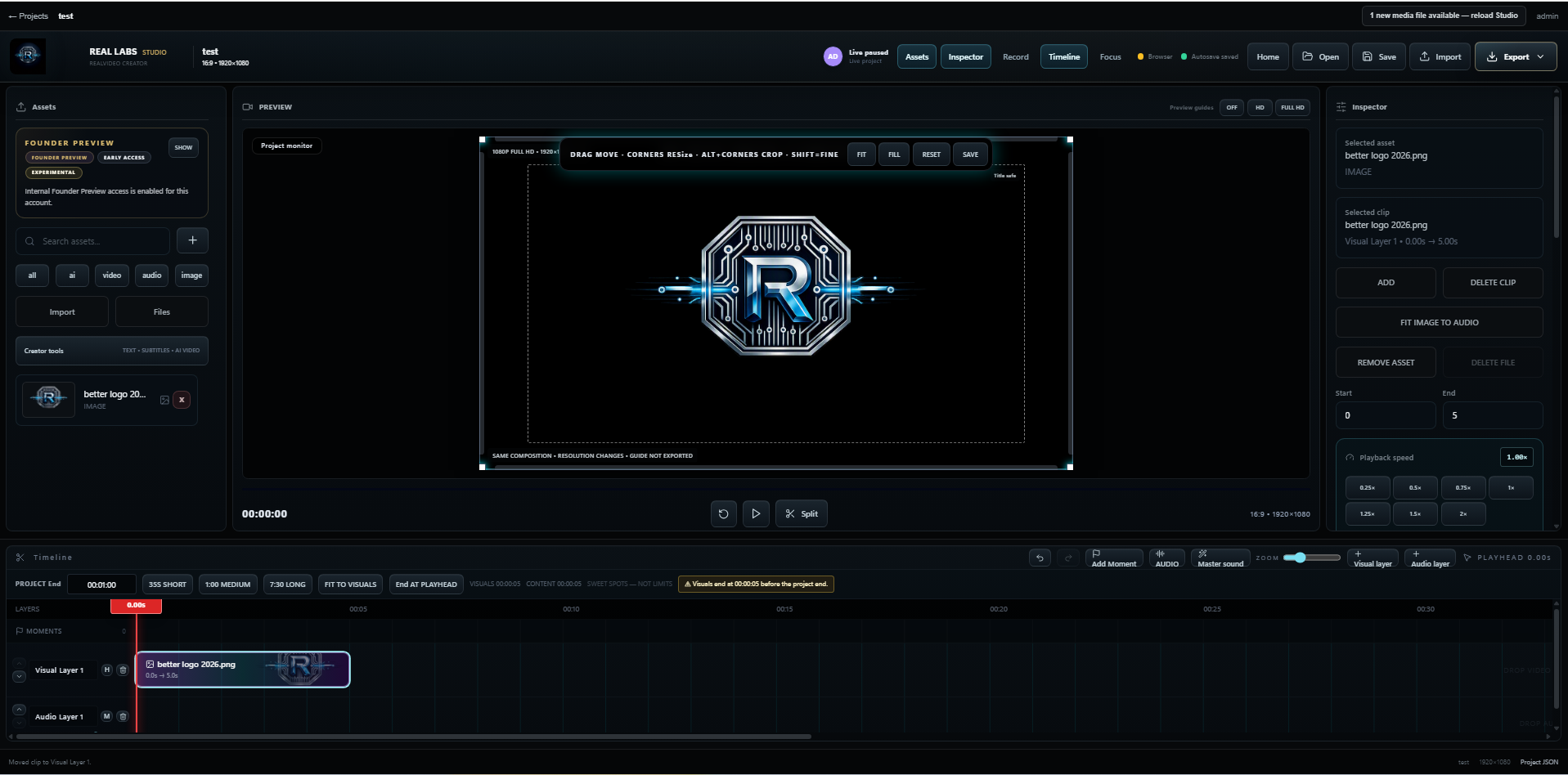
Studio image from October 21, 2026. An account may be required to access the live product.
Capture away from the desk. Keep the work together.
I built a mobile capture workflow so a creator can record video on a phone and send the footage directly into an active RVC project. Instead of transferring files to a computer and importing them into an editor, the creator can bring new footage into the project they are already working on.
Film new footage wherever you are.
Keep captured footage with your current RVC edit.
Assemble the project and prepare your finished video.
Workflow illustration of available mobile-to-project capture. This is not a claim of live mobile broadcasting or verified transfer speed.
RVC is not only a website, and Real Gamers is not only a streaming UI.
My RVC deployment uses dedicated application and media-processing services. My Real Gamers application runs on Windows and uses LUNA for native graphics and streaming.
The 2026 code audits identified implemented architecture and areas requiring further verification. A test definition count is not a passing-test count.
Real Gamers is powered by my own native graphics and streaming architecture.
I wrote the proprietary engineering behind capture, Direct3D 11 GPU composition, hardware encoding, streaming transport, recording and replay. I've used Real Gamers for streaming to Twitch and YouTube, and I recently captured a simultaneous Kick and YouTube founder demonstration.
Rust, Direct3D 11, frame processing and a purpose-built capture-to-stream pipeline.
I can work at the engine level rather than wait for another streaming vendor to ship an underlying feature.
My demonstrations establish working functionality, not third-party-certified scale or performance.
Real Gamers is a separate Windows application, prelaunch for broad customer adoption.
Real Gamers is running on my Windows PC, not inside the RVC web app.
This is a captured Real Gamers live session. It shows the LUNA output selection, program display, clip marker tools, replay buffer, capture diagnostics, and stream controls. The 4K/60 output is a configured mode shown in this session, not a certified long-run benchmark.
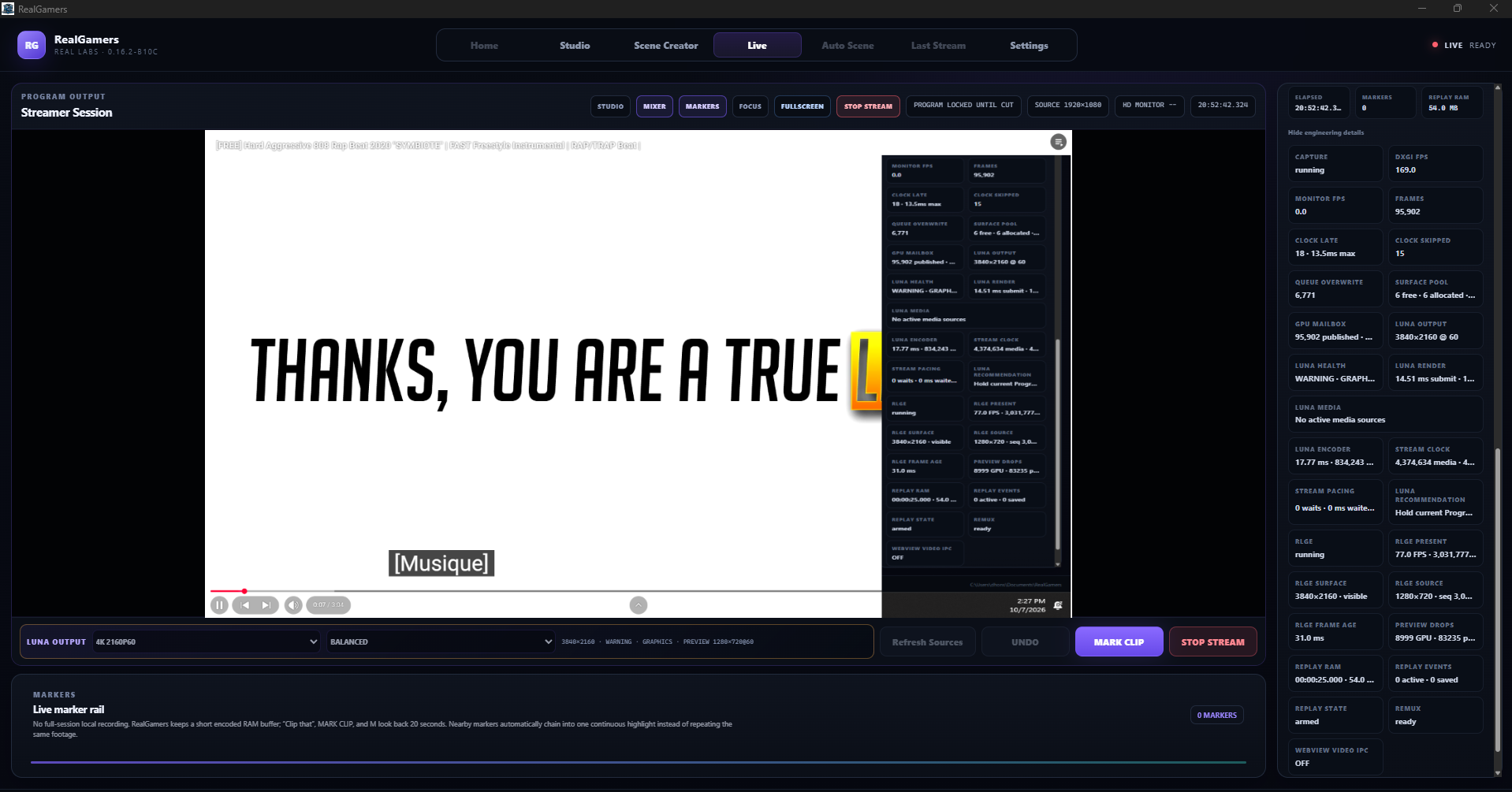
This supports a working native interface and streaming pipeline. The capture also shows diagnostic warnings, which are part of the ongoing performance review.
I captured the broadcaster and both live destination views side by side.
In my own side-by-side test, I observed less than three seconds from the local output to the playback I saw on Kick and YouTube. The screenshots show both destinations and the Real Gamers session; the delay is my observation, not an independent timed certification.
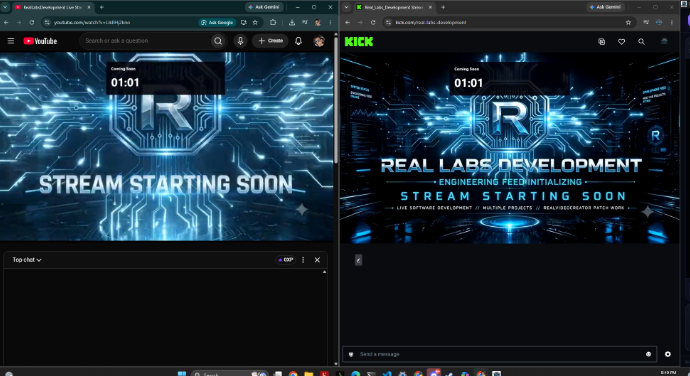
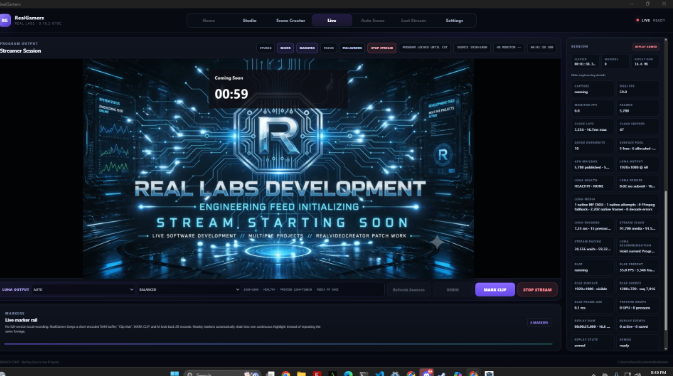
Founder screenshot, September 15, 2026. Viewer latency depends on network, platform buffering, and stream configuration. No independent endpoint measurements have been performed.
Two working foundations with a focused integration roadmap.
My next milestone is shared account authorization and direct transfer of clips into new or existing RVC projects. Creators can then edit, add optional narration, build thumbnails, and prepare content for publication.
Native capture, scenes, streaming, recording, replay and voice commands.
Studio timeline, private projects, VoiceLab, export, billing and paid-generation quotation.
Direct clip handoff, shared access, assisted custom overlays and alerts, and expanded publishing options.
Publishing to third-party platforms depends on their APIs, permissions and approvals.
OBS, Streamlabs and CapCut each solve important parts of a creator workflow.
My differentiation is native LUNA engineering plus an editable-first browser Studio, with a planned direct handoff between streaming and finished content. A large competitor can copy a feature, but replacing the underlying engineering and connected experience takes sustained effort.
I have not yet measured a controlled time-saving comparison or an independent customer switch attributable to the planned integration.
OBS, Streamlabs, CapCut and voice tools solve different parts of the job.
I used products in these categories because they are useful. The creator still has to transfer recordings, locate moments, rebuild context, assemble narration and prepare the finished output between them.
Strong live capture, streaming and scene production. I am not claiming they lack useful clip or plugin workflows.
Editing and content preparation. Depending on the workflow, creators still import recordings from other tools.
Narration and generated speech can become another external production step.
My browser workspace already combines project editing, voice production, private assets, paid-generation quotes and export.
My native LUNA engine powers capture, streaming, recording, voice controls and replay on Windows.
Send a marked RG clip into an RVC project and finish the content without manually rebuilding the workflow.
This is a qualitative comparison of primary workflows, not a benchmark or an exhaustive competitor feature audit. Independent customer switching remains to be validated.
I designed VoiceLab as an adult, self-voice-only feature.
Users must affirm that they are at least 18, that the voice is their own and that they consent to sensitive voice processing. Consent versions, private profiles, access checks and withdrawal and deletion processes are part of the implementation.
I do not permit cloning someone else, even with claimed third-party permission.
Private voice assets and account-linked consent records.
Published restrictions and reporting procedures; identity assurance and end-to-end enforcement continue to require verification.
Consent policy: realvideocreator.com/legal/voicelab-consent/ | VoiceLab is not an identity-verification certification.
These are the numbers I can report today.
I am separating founder testing from genuine customer activity and will publish a dated weekly-active-creator count once verified. I am not calling generation jobs independent customers.
Founder-reported October 26 snapshot; success states and independent-user attribution are not yet fully reconciled.
I am keeping the measurement framework from my original plan and adding the Selected Creator program.
The invitation system exists. Now I need evidence showing that real creators progress through the funnel and keep using the product.
Direct outreach, Discord, human-led creative campaigns and participating streamers.
ContactedRecord channel and cost.
Independent account, first project, finished export and useful product session.
CreatedExclude founder tests.
Personal code, agreed offer and successfully confirmed subscription payment.
PaidNot just claimed.
Weekly independent use, recurring payments, refunds, retention and referrals.
StayedValidate margins.
As of October 26: 5 free accounts, 0 paying, 27 generation jobs. Weekly active independent creators are still unverified.
My acquisition strategy is a 300-streamer Selected Creator partnership program.
I will recruit small and mid-sized streamers through founder-led outreach, creator and gaming Discord communities, 1000 Founders connections and partner referrals. My invitations, unique codes and redemption tracking are already built into RVC.
A personalized invitation, $30/month RVC Pro on a proposed 12-month paid agreement and a $100 signing bonus.
Direct founder access, product feedback and opportunities for recognition or featured promotion.
I will track outreach, accepted offers, verified payments, actual use, referrals and retention.
300 is the program target, not 300 signed agreements. The first 100 paying creators are an acquisition milestone.
I can choose a streamer, personalize the offer, and issue a unique private invitation.
The system supports named invitations, time-limited offers and a private $30/month Pro agreement requiring 12 monthly payments. The invitation is not marked used until a confirmed PayPal subscription payment. These are demonstration screens, not evidence of signed creators.
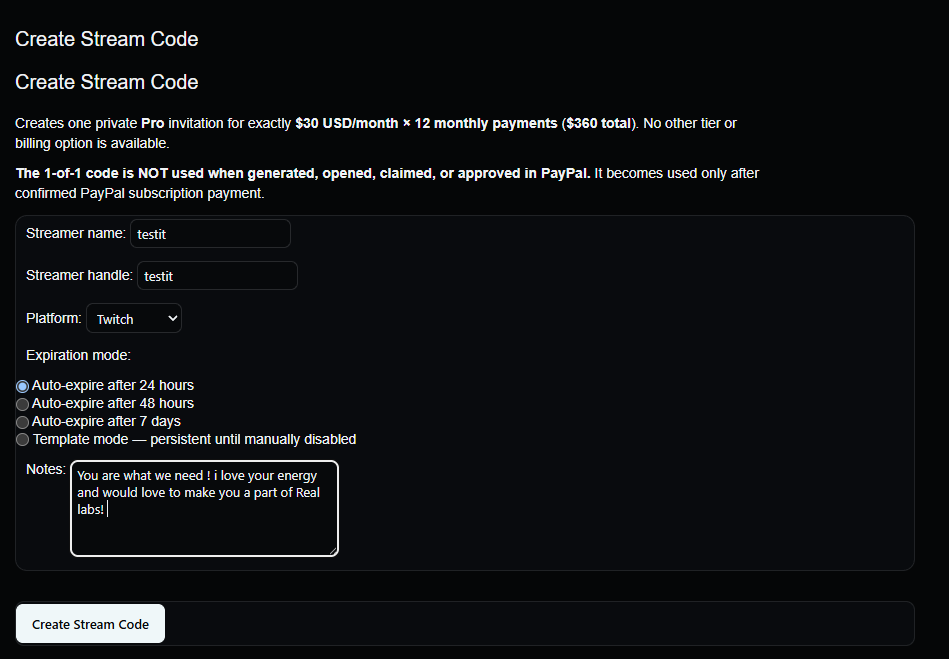
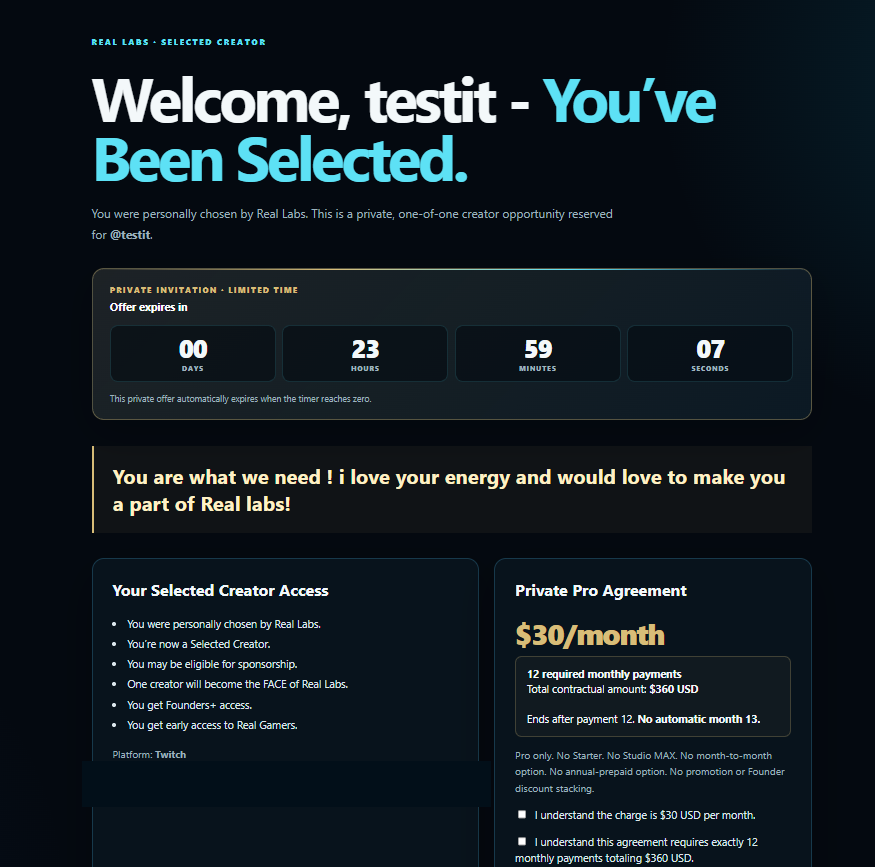
October 26, 2026 demo. 300 partnerships are my recruitment target, not acquired customers. The $100 signup bonus is part of the proposed offer and is not pictured here.
The first creator is not the only person who can discover the product.
RVC already offers free access and watermark-limited export. That can put the product in front of other creators. I want to pair that exposure with tracked creator invitations and human-led outreach, then prove which paths actually convert.
Free creators can produce watermarked exports, subject to the current plan limits.
Use invitation codes and campaign attribution to connect interest with verified paid accounts.
Deliver editing value, consent-based voice tools and reliable service so customers keep paying.
A watermark is a discovery mechanism, not a demonstrated viral growth loop. Referral and export-to-signup conversion must be measured.
Creator subscriptions and expensive generation are separate decisions.
Supported paid generation is quoted and approved in advance, rather than bundled as unlimited usage.
At 300 completed 12-month agreements: $108K potential subscription payments; $48K modeled acquisition spending including bonuses and allocated marketing.
Cash is collected monthly, not upfront. Contribution margin must deduct processing, service costs, failures, refunds and nonpayment.
A public pricing ladder, plus private partnership offers.
The published tiers include Free, Starter at $24/month, Pro at $59/month, and Studio MAX at $120/month on standard month-to-month pricing. The $30/month Selected Creator offer is a separate, private 12-payment agreement. Costly AI video generation is billed per approved quote, not silently included as unlimited usage.
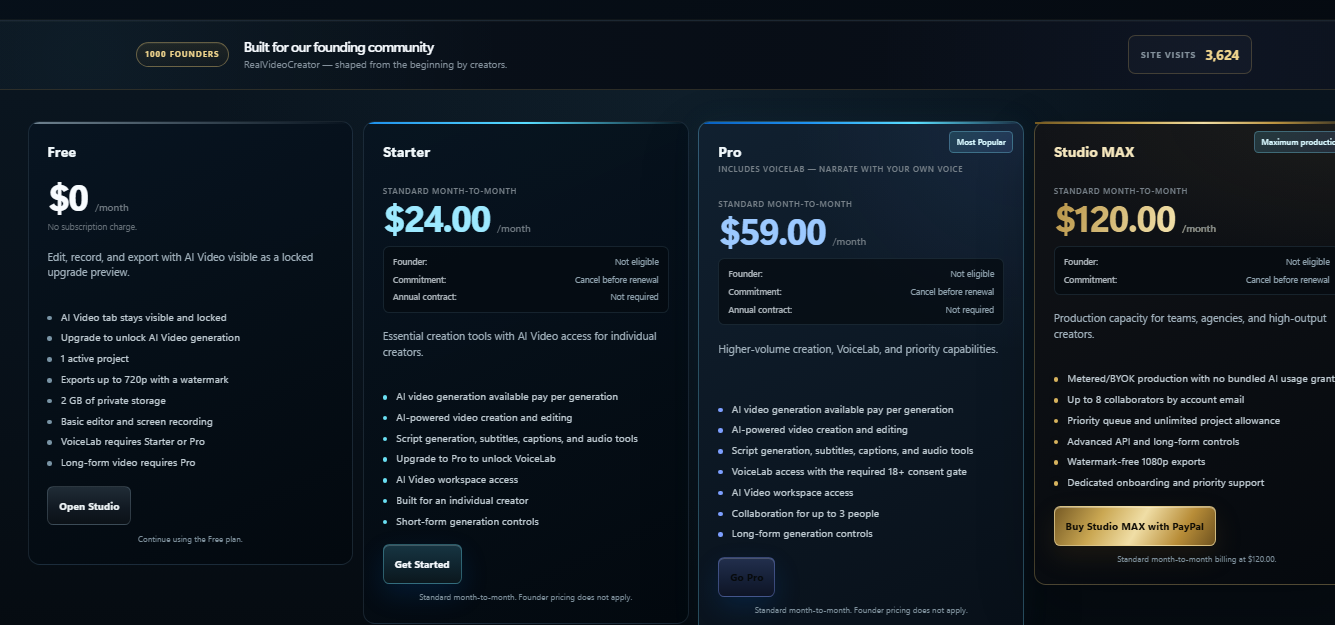
Pricing infrastructure is deployed, but as of October 26 no paying subscribers were reported. Public tiers and partnership contract terms have different eligibility.
RVC has a SOC 2 readiness profile. VoiceLab has published consent, terms and privacy policies.
I personally authored the proprietary Real Labs code, including LUNA. Formal company IP assignment and legal-chain documentation will be reviewed before investment close.
Private media access, consent controls, transactional billing, audit trails and strengthened service sandboxing.
SOC 2 readiness is not an issued Type I or Type II attestation. Additional test execution and scale verification remain.
I intend to complete standard SAFE documentation and the appropriate Delaware C-corp conversion with counsel.
Ordinary third-party software dependencies and provider services remain; “original code” does not imply an ecosystem with zero external dependencies.
My first engineering hire reduces the key-person risk. Human-led marketing builds distribution.
I want an engineer who can take ownership of deployments, runbooks, incident response and reliability. I also want experienced marketing professionals developing real campaigns and relationships with creators.
Document operations and transition critical systems so they no longer depend on one person.
Build a recognizable brand and measure performance, rather than rely on generic AI-generated ads.
My planned $125K salary supports full-time leadership and engineering work; the historical $190 cash burn excluded my pay.
These are hiring priorities, not existing employees or contracted advisors.
Asking for less would leave the commercialization work underfunded.
I want to fund the right hires, a serious marketing effort, product integration, reliable operations and a financial cushion. My goal is to reach sustainable operations without depending on another raise, although I cannot guarantee that outcome.
Includes planned $125K founder salary; reconcile the remainder with payroll and product costs.
Technical capacity, Real Gamers launch features and integration work.
Creator partnership bonuses, broader marketing, human-led campaigns and onboarding.
Media workers, compute, hosting, delivery and operational capacity.
Counsel, SOC 2 readiness follow-through, accounting and external reviews.
Contingency for unexpected costs.
Total: $500K. Planning allocations, not approved contracts. $30K of the acquisition allocation may fund 300 creator bonuses.
I am restoring the quarterly capital schedule from my earlier deck.
The existing six-category $500,000 budget remains intact. These quarterly figures show the planned timing of that same budget, not extra spending on top of it.
Prior planning schedule: Q1 $100K, Q2 $115K, Q3 $130K, Q4 $155K. These do not constitute committed expenditures.
I am retaining the milestone plan from my original deck and connecting it to my updated 300-creator partnership strategy.
The numbers below are cumulative, proposed checkpoints for independent creators. The 300-partnership program is a recruitment target; it is not 300 signed customers today.
Measurement, first hires and paid creator conversions.
5 paying100 signups · 30 exporting creators
Onboarding, outreach learning and initial creator graphics work.
15 paying300 signups · 100 exporting creators
Test RG-to-RVC handoff and retention with real creator cohorts.
45 paying750 signups · 250 exporting creators
Commercial outcomes, reliability and next-year sustainability decision.
100 paying1,500 signups · 500 exporting creators
Milestone targets are founder plans, not historical traction, contracts, signed partnerships or guaranteed forecasts.
The first six months establish a measured growth process before I increase spending.
All creator and payer numbers are cumulative proposed quarter-end goals, not current performance.
The second six months turn early product use into a repeatable customer business.
Customer targets are cumulative planning goals. Platform integrations remain planned until tested and released.
The first 100 paying creators are progress, not a claim of profitability.
At the Selected Creator rate, 100 paying customers would contribute $3,000 in monthly subscription billings and 300 would contribute $9,000 before costs. A $500,000 first-year investment plan cannot be supported by those figures alone.
Continue beyond selected streamers through regular subscription tiers, upgraded creators and products creators use repeatedly.
Quote variable AI generation before approval; reconcile realized provider, worker, payment and refund costs.
Release marketing and development spending based on measured paid conversion, retention and service demand.
The break-even payer count depends on verified operating expenses, customer mix and contribution margin; it has not yet been established.
My intention is one SAFE with startup counsel handling the documents.
My earlier investor materials discussed a $10 million post-money valuation cap and a 20% conversion discount. Those are indicative negotiation terms only; I will have counsel confirm the structure and the applicable conversion calculation.
Not a securities offer or executed term sheet. An instrument containing both cap and discount requires appropriate drafting and counsel review.
My first 100 paying creators are a checkpoint, not my break-even target.
Verify independent usage, launch personalized outreach and measure first paid conversion.
Prioritize creator overlays, alerts and direct Real Gamers-to-RVC clip handoff.
Validate CAC, cost per generated minute, payment realization, margins, retention and service reliability.
Stage hiring, adjust acquisition spend and narrow scope if conversion or retention miss assumptions.
See the dated quarter-by-quarter timeline and capital schedule above. The operating checkpoints are targets, not confirmed performance.
My technical work is substantial. Commercial proof is the next milestone.
The open questions include customer retention and willingness to pay, realized unit margins, sustained multi-tenant load, certain worker resource boundaries, and independent security validation. My recent review shows improvements in service hardening, but not closure of every historic finding.
A technical audit establishes what was inspected. It does not automatically establish product-market fit, load capacity or full SOC 2 attestation.
Seeking $500,000 through a single proposed SAFE, with terms reviewed by counsel.
I want to build a company that recognizes smaller creators, keeps the human in control and provides a complete path from an idea to finished content. I am looking for investors who understand the engineering and want to help me prove the business.
Investor overview, October 26, 2026. Figures and forward-looking plans subject to due diligence.
Market research is context. Product screenshots and source audits are internal evidence. Projections are forward-looking.
Creator context: Goldman Sachs Research, April 19, 2023 (the widely cited 50 million global creators estimate); IAB, April 16, 2026 (2025 U.S. creator advertising reached approximately $37 billion). Advertising spend is not RVC software revenue.
Current product evidence: Real Labs founder-provided screenshots of RVC Studio, Real Gamers running, Kick/YouTube playback and Selected Creator administration. Specific streaming delay is an observed demonstration, not an independent benchmark.
Operating figures: Founder-reported RVC snapshot dated October 26, 2026. Independent weekly active users and paid conversion remain to be verified.
Engineering evidence: September 2026 RVC and Real Gamers code audit reports; October 26, 2026 staged RVC re-audit. These are evidence of inspected implementations, not formal security certification or proof of commercial-scale reliability.
Consent and privacy: VoiceLab consent policy, RVC terms, RVC privacy policy.